ETS surgery is permanent, so start with Alisha's real life experience before you decide anything. If you are not sure what this surgery is, the overview below explains the basics first. Excessive sweating can happen when the sympathetic nerves become overactive and keep signaling the sweat glands too strongly. Endoscopic thoracic sympathectomy, or ETS, interrupts those nerves with surgery.
What ETS surgery does
The thoracic sympathetic chain has 12 segments, named T1 through T12, and different forms of hyperhidrosis are linked to different target levels. The image below shows Corposcindosis, or Split Body Syndrome, where one half of the body can show a very different temperature. That can make a person feel split in two, which is one reason this kind of nerve surgery should never be treated lightly. Many sites still avoid discussing poor success rates and severe side effects, so patient stories often fill in the gaps.
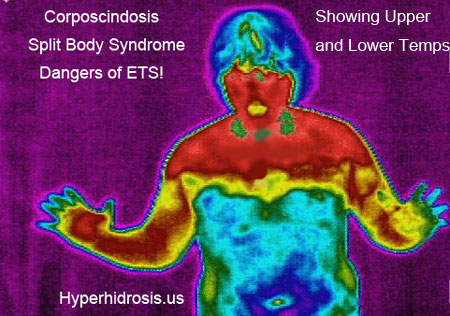
ETS can help some people significantly, but the tradeoffs are not small. Patients deserve a clearer picture than simple promises about low risk and fast relief. Understanding how the procedure is done can make the decision feel more concrete and less abstract. That is especially important when a single surgery can change sweating patterns across the whole body.
How surgeons perform ETS
ETS uses small incisions in the underarm area, and the patient is under general anesthesia during the procedure. The risks are often described as low, and the results are often described as satisfactory. Even so, surgeons do not all use the exact same method, and those technical differences matter. Some approaches leave more room for reversal than others, which changes how patients think about risk.
Clamping or clipping ETS (ETS-C / ESB)
This method does not cut the sympathetic nerves. A titanium clamp presses on the nerve and blocks the signal instead of destroying the tissue. The sympathetic ganglia are not destroyed during this approach, which is why some people see it as less final. That can leave room for later reconstruction if the clamp is removed early enough.
Cutting selected nerve segments
Some procedures cut selected segments of the sympathetic chain. Reconstruction is very unlikely after that kind of surgery. Surgeons use this method when they want a permanent interruption of the nerve signal. That permanency is one reason patients need to research the decision very carefully.
Electrocautery or surgical scissors
Surgeons may also cut the nerves with electrocautery or surgical scissors. This method also makes reconstruction difficult once the nerve has been interrupted. It is another example of how ETS can vary from one operating room to another. Small technical differences can shape long term results in a major way.
Which ETS levels match each sweating problem
Surgeons target different levels depending on where sweating occurs and what symptom they hope to reduce. Facial blushing is usually linked to T2, while facial sweating is usually linked to T2 or T3. Hand sweating is usually linked to T3 or T4, and underarm sweating is usually linked to T4 or T5. Those level choices help explain why one form of ETS is not identical to another.
- Facial blushing: T2
- Facial sweating: T2 or T3
- Hand sweating: T3 or T4
- Underarm sweating: T4 or T5
What side effects can happen after sympathectomy
Compensatory sweating is unpredictable, and its severity varies widely from person to person. Hot weather often makes it worse, although some patients notice only mild moisture. Many patients say they would still choose compensatory sweating over their original condition. Others do not feel that way after living with it for years.
If compensatory sweating becomes severe after clamping, the titanium clamp may sometimes be removed. Reversal works best soon after surgery, and the chance drops sharply after a few months. Larger denervation areas usually cause stronger compensatory sweating. Older methods cut longer nerve sections and often caused more side effects.
Modern targeting is more precise, and surgeons try to limit compensatory sweating by treating only the needed section. Robinul and Ditropan may help some people manage the extra sweating afterward. Other risks include nerve damage, bleeding, infection, rib pain, dryness, and a lower heart rate. Rare complications include lung damage and Horner's syndrome, although improved methods have made them less common.
When insurance may cover hyperhidrosis treatment
Some insurers consider Botox or iontophoresis medically necessary for disabling primary hyperhidrosis. That usually requires failed topical aluminum chloride or another extra strength antiperspirant, or a severe rash from using one. The person must also be unable to tolerate or respond to prescribed medicines. Insurers also look for major disruption in professional or social life before approving more advanced treatment.
After Botox and iontophoresis fail, insurers may also consider several surgeries medically necessary. Those procedures range from open thoracic sympathectomy to VATS, ETS, and excision of axillary sweat glands. Some policies also mention lumbar sympathectomy and tumescent liposuction for axillary hyperhidrosis. Coverage rules vary, so patients still need to check the details of their own plan.
- Open thoracic sympathectomy
- Video-assisted endoscopic thoracic ganglionectomy (ETG)
- Endoscopic sympathetic ablation by electrocautery
- Chemical thoracic sympathectomy
- Thoracoscopic sympathectomy
- Endoscopic thoracic sympathectomy (ETS)
- Video-assisted thoracic sympathectomy (VATS)
- Excision of axillary sweat glands
- Lumbar sympathectomy
- Tumescent liposuction for axillary hyperhidrosis
Alisha's ETS surgery story
I had ETS, using the nerve cut method, in 1998 for extreme hand sweating. This is my story before and after surgery. Your experience may be different, so please research carefully before deciding on hyperhidrosis treatment. I was 22 when I had ETS, and my social life already felt badly affected by sweating.
My first memory of sweaty hands is from fourth grade. My teacher looked disgusted and told me to wash my hands in front of the whole class. After that, I kept washing them at our classroom sink, and everyone knew why I was there. I also kept paper towels at my desk so I would not soak the papers I handed in.
My mother took me to doctor after doctor for help. I was given medicines that made me drowsy, very thirsty, or spaced out, but none of them worked. I was also given a Drionic machine, and it burned my hands every time I used it. That was in the early 1980s, and the technology was not what it is now.
My teenage years felt even more stressful because I was already dealing with hormones and identity. I was also hiding my sweating secret, and I did not have a boyfriend in high school. Many boys asked me out, but I made excuses because I feared any attempt to hold hands. That fear shaped almost every social decision I made.
Prom and homecoming were awful because strapless dresses showed my underarm sweating right away. If I wore sleeves, the underarm area soaked through before I even left the house. Shoes were just as hard, so socks and sneakers felt like the only safe choice, and sandals felt impossible. The rare times I wore heels, puddles of sweat collected in them.
One homecoming night, I dyed heels burgundy to match my dress. My feet sweated so much that the dye seeped through the shoes, and people could follow the trail across the gym floor. It took more than a week to scrub the color off my feet. Small moments like that made me feel watched all the time.
Job interviews were another nightmare, and denim was the only fabric that seemed to blot hand sweat. That did not help much in an interview because I hated the unavoidable handshake. People rarely said anything, but they usually wiped their own hand afterward, and the silence made it worse. Before one interview, I rubbed my hands on my front tire and used the grime as an excuse to visit the restroom.
After washing up, my hands were damp again, and I had no excuse at the end of the interview. Sweat was dripping from my hands, and I did not get the job. By my early twenties, I had enough. My steering wheel slipped in turns, and I dropped trays while waitressing.
I feared handshakes, dates, light switches, soaked underarms, bare feet, and flip-flops in the Florida heat. Concealing my sweating controlled my life, and I finally found ETS while researching a cure. At that time, only a few doctors in the United States were doing it. I flew from Florida to Houston for a consultation because I felt desperate for something permanent.
The doctor said ETS was only for extreme cases, but I was not worried because I knew mine was extreme. When he entered the exam room, he shook my hand and smiled. He said, "You weren't kidding." It felt good to be understood. He also said ETS would completely stop my hand sweating while only reducing foot and underarm sweating. The next morning I went into surgery, and my life changed at that moment.
I woke up with dry, warm hands and feet, but soon after the doctor said he had tweaked another nerve. That gave me mild Horner's syndrome, and I asked for a mirror immediately. It looked awful because my left eye barely opened. He said it would improve with time, and I checked the mirror every day for almost three months.
He was right, because it improved enough that most people never notice it now. I still notice it when I am very tired, after too much wine, or sometimes in photographs. No one comments on my smaller eye unless they already know the story. Even now, that memory reminds me how quickly one surgery can create a new lifelong worry.
I had moderate chest pain after surgery, and deep breaths were hard during the first week while the incisions under my arms stayed sore. For a while, I had phantom tingling that felt like sweat was about to start, but my hands never actually sweated. My feet and underarms started sweating again a few weeks later, although not as badly as before. The tingling lasted about a month.
My first downside, besides Horner's syndrome, was constant hand dryness, and I carried travel hand lotion for about six months. Even that still felt better than years of sweaty hands. Then compensatory sweating started, and I think it began between six months and one year after surgery. It affects my torso, groin, and buttocks during high stress, anxiety, or extreme heat, which matters because I live in Florida.
I have to plan clothing around weather, company, and anxiety level, or the sweat stains show. I do not get compensatory sweating around close friends, family, or while relaxing at home. Right now, as I write this, I am dry from head to toe, and most errands or dates with my husband do not trigger it. It usually starts in group settings and stops as soon as I leave the group.
Outdoor picnics and barbecues are a major trigger in Florida, although a wet shirt looks more normal in that heat. Around the same time, I also developed gustatory sweating, which means facial sweating while eating. It is worst in public restaurants, so I manage it by holding a paper napkin throughout the meal and blotting around my mouth. Every few blots, I also dab my nose or forehead.
I do not think most people notice it because I time the blots when others look down at their plates. I can also blame warm restaurants or spicy food if I need an explanation. Strangely, gustatory sweating happens only when I eat in public, and I do not get it while eating a sandwich at home. I think my compensatory and gustatory sweating are mild, but I am not dismissing anyone whose symptoms are more severe.
I can only describe my own outcome. After reading many testimonies, I consider myself one of the lucky ones, but there is still no way to predict severity. Compensatory and gustatory sweating are very common after ETS, and how severe they become is a gamble. Aside from Horner's syndrome, compensatory sweating, and gustatory sweating, I have not had other side effects, although that could still change with time.
It has been 13 years since my ETS for sweaty hands, and my hands do not sweat now. My feet sweat about half the time, and my underarms also sweat about half the time. I do have mild to moderate compensatory and gustatory sweating about 80 percent of the time, but only socially. They do not destroy my life the way sweaty palms did, and I manage them with careful clothing choices.
Would I do ETS again? Maybe, maybe not. I would first explore non permanent and non toxic options, and if those failed, I still do not know what I would choose. I now sweat over a larger body area, which is harder to hide during intense stress, and events like weddings, parties, speeches, and gatherings take more effort. Sometimes I wonder if I would prefer sweaty hands without compensatory sweating, and other times I value feeling normal and sweat free.
ETS offers no guarantees, and it does not promise a perfect ending. Only you can decide what is best for you. ETS is elective surgery, and it comes with real complications and side effects. Be your own advocate, do your research, stay informed, weigh every option, and best wishes to you.
Ian's story
Below is Ian's story, and I am grateful he shared it. I am 31 and live on the East Yorkshire coast in England, and I had ETS on the NHS in April 1999 for palm sweating. I needed a second ETS in May 2000 because both hands still sweated at times. I later had lumbar sympathectomy in May 2001 for foot sweating.
Since early 2002, I have had severe compensatory sweating on my back, stomach, sides, and legs. I also struggle with heat intolerance and constant flushing. The list below shows the other symptoms that followed. Together they changed my daily life far more than I expected.
- Lack of emotional feeling, including an inability to cry
- Tiredness and severe loss of energy
- Weight gain, which I link to low energy and heat intolerance
- Feeling dehydrated no matter how much water I drink
- Headaches
- A burning feeling in my back, stomach, chest, and legs
- Feeling faint in heat, even in mild or cool weather
- Dizziness
- Embarrassing compensatory sweating that caused depression and very low confidence
- Very little sweating from my underarms, face, scalp, forehead, and neck
- Very dry and itchy forehead
- Extremely dry hands and feet, even after a 60 minute treadmill workout
I tried Avert, Robinul wipes in 1, 2, and 3 percent strengths, and aluminum chloride antiperspirants, including Driclor, Odaban, and Sweat-Stop. None of them really helped my compensatory sweating, and the side effects were awful whenever they did help. For the last seven years, I have focused on general health and nervous system support in the hope that my body might recover. I do tai chi, acupuncture, and food based omega 3, 6, and 9 supplements, and tai chi also helped me lose a stone this year.
I still feel hurt, and a little bitter, toward the NHS because I was sent from a dermatologist straight to a surgeon at age fifteen. No one told me about Botox, topical medicines, oral medicines, or iontophoresis. I believe iontophoresis, strong antiperspirants, and counseling could have helped, and that might have addressed school bullying without surgery. Still, you can only act on the information you have at the time.
My advice is simple: do not have this surgery. My quality of life was at least ten times better before it, and I miss summer days at the seaside, rugby in the heat, and many other things. Please be thankful for what you still have, because things can become much worse. Thank you to the site owner for giving ETS patients a place to share, and I truly appreciate it.
Tom's story on ETS side effects
Reading other people's stories reassured me because, until then, I knew only one other person with the same problem. She was a woman I dated once, and she used Botox instead of surgery. I still remember wet school papers, dropped balls, and field trips where other kids refused to hold my hand. Those moments created deep social insecurity, and they stayed with me for years.
My name is Tom, I am 26, I am from Israel, and I had ETS in August 2011. That was about 3.5 years ago when I wrote this, and before that I assumed no real solution existed. In high school, I heard about Drionic and imported one before it was officially sold in my country. I spent many boring sessions sitting still for about an hour because my feet and palms had to stay almost motionless.
Sometimes I thought sweating improved, and other times it felt like wishful thinking. Thinking about sweat can trigger the tingly feeling before it starts, and I knew that feeling very well. Before surgery, the doctor told me the side effects were limited, and he mainly mentioned compensatory sweating. He said it could appear in unknown places, and he also said ETS would stop underarm sweating but not foot sweating.
He told me foot sweating needed a different surgery, and that surgery was not done at this hospital for cosmetic reasons. I was told other side effects usually came from surgical failure, and my surgeon was considered one of the best in Israel. My father knew him, and that made me feel safer. Looking back, that reassurance mattered a lot to me at the time.
After surgery, I stayed in the hospital overnight for monitoring, and the sweating had stopped, which felt strange. I had minor dissolvable stitches in my underarm, and even now the scar is hard to see. For several months, I felt phantom sweats and tingling as if my palms were sweating. I would wipe them on my jeans and find nothing there, which felt strange but also wonderful.
The phantom sweats faded as I adjusted, and then I became more aware of compensatory sweating. I now sweat about as much on my lower back as I once did on my palms, and I also sweat somewhat in the buttocks. My feet may also sweat more, but I am used to that and do not think twice about wet socks. Spicy food makes my forehead sweat, and reading this page made me wonder whether surgery caused that too.
I also feel the need to drink a lot of water, and that need feels stronger now than it did before surgery. Overall, I feel I made a fair trade because one major problem was replaced by several smaller ones. The old problem shaped my body language and confidence, and I still catch one hand grabbing the other. When my back sweats, I wear an undershirt on hot days and carry spare clothes and deodorant.
Butt sweating is harder to see in jeans, which helps because jeans are common at work. Gustatory sweating feels manageable, and I usually joke that my body handles spicy food badly and wipe it away. Other people do not make a big deal of it, and I try not to either. That mindset has helped me live with the tradeoffs more calmly.
If I had the choice again, I would still choose surgery, even knowing these side effects. I am also sharing this so someone else feels less alone, because there is one more person with a similar story. In the last two months, another side effect appeared, and my hands now get cold very easily. The fingers are the worst, and my feet do it too, although less severely.
Even hot water helps only briefly. The cold returns quickly when I am idle at home. I notice it less when I am out all day, and exercise keeps them warm for a few hours. A warm shower also keeps them warm through the night.
Still, this new problem worries me. I wonder whether it will continue in summer, and I also worry about other side effects appearing years later. I hope this account helps anyone considering an irreversible procedure, even though I would still prefer this over twenty three years of sweaty palms. Even so, the complications are real and highly individual, and surgery should be the last option because Drionic did little for me and Botox felt too expensive to try.
What Our Community Says
Insights drawn from hundreds of reader experiences shared on this site.
"Many people said ETS reduced or stopped sweating in the original problem area. The biggest question was what tradeoff followed after surgery."
- Community member who had ETS surgery
"Compensatory sweating was the most repeated warning in the comments. Some described it as mild and manageable, while others said it changed daily life for the worse."
- Community member living with compensatory sweating
"Readers also mentioned dry hands, heat intolerance, dehydration, chest pain during recovery, and sweating shifting to the back, stomach, or legs."
- Community member after recovery
"A recurring theme was to exhaust non surgical treatments first. People often wished they had been told more about iontophoresis, topicals, oral medicine, or counseling earlier."
- Community member who wished for more options
"For people already dealing with compensatory sweating, some found partial relief from antiperspirants, glycopyrrolate, exercise, weight loss, or cooler climates."
- Community member managing side effects